Court hears complex testimony in Sanchez evidence suppression motion
The NMI Superior Court convened for an evidentiary hearing to address a motion to suppress evidence in the case against Kelvin Cabrera Sanchez last Nov. 20 at the NMI Superior Court in Susupe. The hearing presented a dive into the intricacies of law enforcement protocol and constitutional safeguards.
Chief Prosecutor Chester Hinds and assistant attorney general David Karch represented the government and Molly Dennert represented Sanchez on the matter.
The proceedings built on a foundation of a prior ruling, which included a July court order granting suppression in a separate case involving Sanchez, due to constitutional violations. Both parties questioned witnesses, going over testimony, to determine whether a warrantless search of a vehicle and the subsequent discovery of narcotics should be suppressed.
The motion centers on a July 2024 incident at the Saipan Vegas parking lot, a place according to officers as a known hotspot for drug activity, where Sanchez was found in a vehicle linked to another wanted individual. Sanchez was arrested on contempt of court charges, not being with his third-party custodian, according to the Department of Public Safety reports. DPS officers impounded his car and conducted a K-9 sweep that led to the discovery of a backpack containing drugs and identification.
The prosecution presented testimony from multiple DPS officers and experts to establish the vehicle’s connection to Sanchez and justify the search. The defense countered by questioning procedural inconsistencies, especially the lack of adherence to written impoundment and inventory search policies.
The prosecution’s key witnesses were officers under DPS, Criminal Investigation Bureau, and Drug Enforcement Task Force. The men testified about the vehicle’s impoundment and K-9 sweep. However, all admitted being unaware or unfamiliar of a formal policy mandating such actions in a red zone. Officers echoed uncertainties, describing the Saipan Vegas area as fraught with illicit activity but conceding their lack of familiarity with procedural requirements.
The car’s last registered owner was also placed on the stand and testified that he sold the vehicle in 2022, but could not recall the buyer. According to a woman who earlier spoke to police, Sanchez had been borrowing the car from the man who was off-island. The man said he neither knew nor could identify Sanchez and that, he personally had never left the island at that time. Prosecutors mentioned that the vehicle’s registration expired in May 2023, making it unregistered, at the time of the incident, and according to testimony of several officers it was legal that DPS could impound the vehicle.
A police detective, who first alerted other officers of Sanchez’s “contempt of court” charge, testified that impounding the vehicle was done for safekeeping, not because of suspected narcotics. The decision, along with the K-9 sweep, became a focal point of defense arguments.
Dennert focused on DPS policies, asserting that no written directive mandated the impoundment or search. Each officer acknowledged the absence of completely clear guidance in the decision, with some admitting to never having fully reviewed departmental manuals.
Dennert also questioned the reasoning behind the K-9 sweep and subsequent inventory searches, arguing they exceeded constitutional limits and lacked justification under Fourth Amendment protections.
Overall, the prosecutions move on the evidentiary hearing was to bring new evidence and witness testimony to counter the court granting the defense’s motion to suppress evidence in the Commonwealth v. Sanchez case. In that order, issued in July, Associate Judge Joseph N. Camacho suppressed evidence after finding that DPS officers violated Sanchez’s Fourth Amendment rights. That case involved a pat-down and vehicle search initiated without reasonable suspicion, culminating in the court ruling that the searches were unconstitutional.
In the July ruling, Camacho determined that:
DPS officers failed to establish reasonable suspicion to stop or search Sanchez.
The searches did not meet exceptions to the warrant requirement.
The impoundment and inventory search of a vehicle not registered to Sanchez were unjustified.
The defense leveraged this ruling, arguing that similar lapses occurred in the current case.
Camacho, who presided that day over the case, questioned the necessity of multiple searches and expressed concerns about procedural ambiguities. He asked that if an inventory search was conducted, what prompted the K-9 sweep? Wasn’t the discovery of narcotics inevitable under standard procedures? The officer to which the question was posed, didn’t answer.
Both sides have until Dec. 13 to submit their proposed orders. Hinds shared that due to the process, the court’s ruling will likely come early next year. Sanchez is currently released to a third-party custodian.
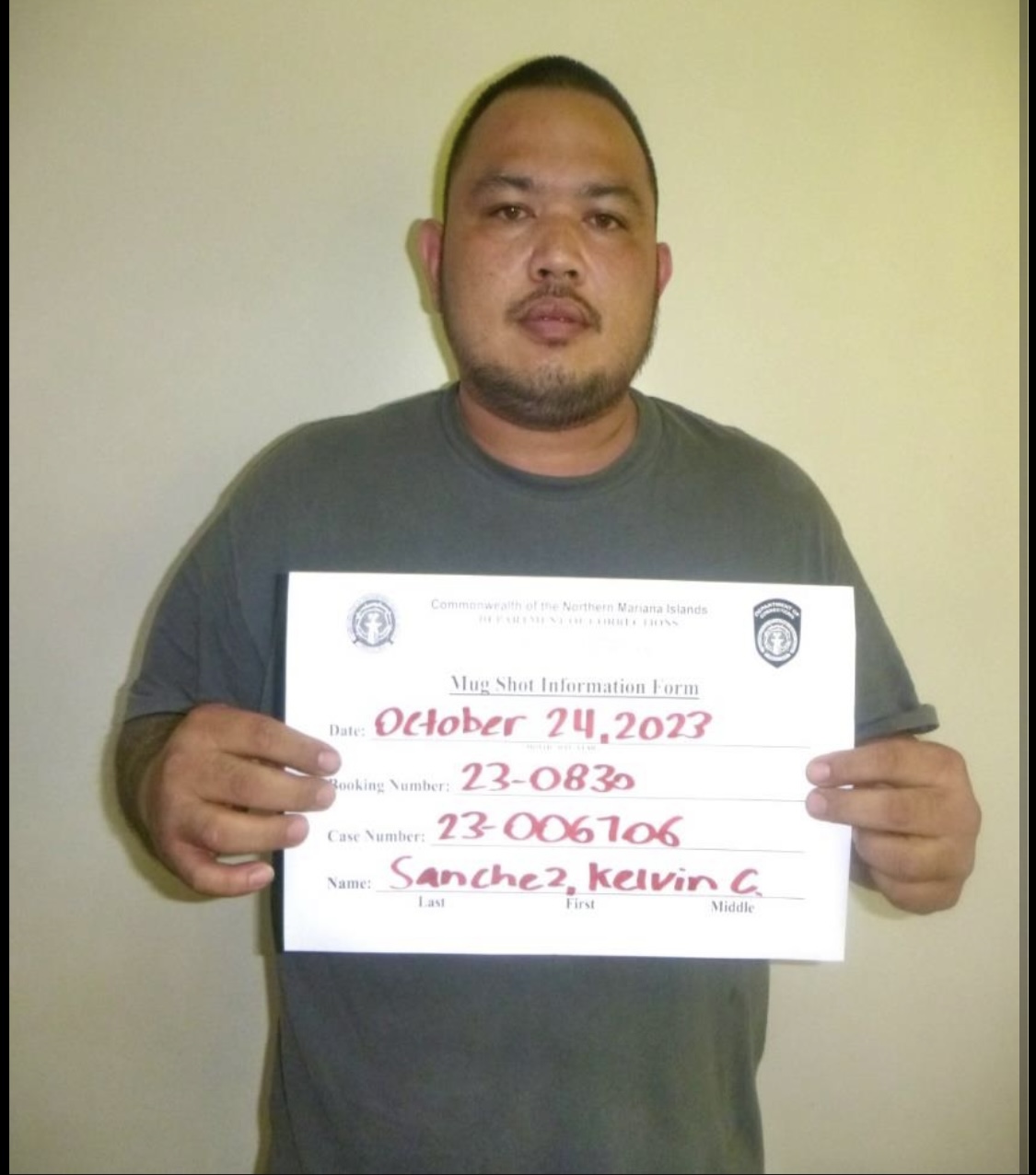
A police mug shot of Kelvin C. Sanchez.
-DPS