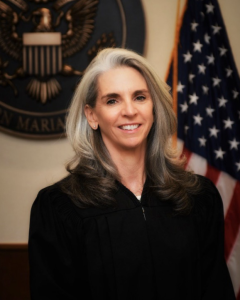
33% drop in JVAs since 2019
Department of Labor Secretary Leila Staffler said Job Vacancy Announcements have dropped 33% in the past four years, which clearly indicates the dwindling number of CNMI-Only Transitional Worker employees in the Commonwealth.
Serving as guest speaker of the Marianas Business Network mixer last Wednesday at the Tom Yum Restaurant in San Antonio (see related story on Page 2), she presented Labor’s Job Vacancy Data-Yearly Comparison where it showed that from 34,246 in 2019, JVAs had a precipitous drop to 20,991 in 2020.
It went down further in 2020 and 2021 at 16,017 and 18,699, respectively, before JVAs had a resurgence in 2023 with a four-year high of 23,002.
In terms of CWs making up the workforce, Staffler said it was 27% in 2019, 55% in 2020, 35% in 2021, before settling back to 27% in 2022. Statistics for 2023 are not yet available.
It’s interesting to note that JVAs significant 53% drop in 2020 was due to the COVID-19 pandemic, but curiously the year also had the highest percentage of CW workers in the labor force at 55%.
Staffler said data gaps hinder precise job creation count from 34,000 impacted jobs, adding that the change in U.S. law in 2019 shifted focus from construction to installation, maintenance, and supply. She said the construction industry remains the primary driver of job loss issues in the CNMI.
She also addressed skilled labor shortage, particularly in the context of construction and renovation projects. The need for specialized skills was also emphasized and Labor’s establishment of skills campuses aims to address this issue and mitigate brain drain caused by migration.
Furthermore, Stafflr also mentioned other challenges of worker development in the CNMI that includes the economic impacts of federal regulations, phase-out of the CNMI-Only Transitional Worker Program in 2029, and the aging workforce.
Staffler discussed uncertainties surrounding business prospects due to the renewal processes.
“Also, another big issue right now and has been since I became secretary of are the impacts of the regulations on CWs, touchback, all those things. Because that creates gaps in labor access, which can really harm your business, especially if they have skilled requirements,” said Staffler.
And don’t forget the looming question mark presented by the approaching end of the CW program in 2029.
“Of course, the cliff that’s just around the corner with respect to the transition out of the CW program in 2029 because that’s when the law is supposed to take effect and right now because of the political changes that are happening in America and the election coming up, who knows who our President will be and who has control of the House and the Senate… Those are the people who will have the power to change, extend or whatever they do, not us,” said Staffler.
The Labor chief also mentioned that the aging workforce presents challenges as more and more experienced workers retire.
There is also a need to focus on growth in IT and cybersecurity, according to Staffler. Ditto for renewable energy with more and more solar and other renewable energy programs being implemented on island. She said efforts are being made to ensure all islands in the CNMI have full connectivity and access to necessary resources.
Lastly, Staffler said economic diversification is crucial for the Commonwealth as tourism as the CNMI’s primary economic driver faces a lot of challenges.
Labor pix