Abraczinkas seeks acquittal after guilty verdict in jury trial
In a riposte following the jury’s guilty verdict in the rape trial of William Abraczinkas, defense attorneys involved in the former NMI Superior Court law clerk’s trial filed a motion last Friday for the judgment of acquittal for all charges against him.
Abraczinkas, who was found guilty on charges of sexual assault in the first degree, assault and battery, and disturbing the peace, has filed a motion seeking acquittal, claiming the prosecution failed to prove its case beyond a reasonable doubt. The motion, filed by his defense attorney Charlene W. Brown, argues that the evidence presented during the jury trial, which concluded last Sept. 13, was insufficient to sustain the conviction.
The jury trial, which spanned five days, saw testimonies from several law enforcement officers and the alleged victim. Despite the defense’s initial motion for acquittal being denied at the close of the prosecution’s case, Brown renewed the motion following the guilty verdict, citing procedural rules that allow such a motion within seven days of the jury’s decision.
The defense’s argument hinges on the lack of corroborative evidence. Brown claimed that during the trial, the prosecution presented the alleged victim’s testimony as the primary evidence of the defendant’s guilt. However, the defense pointed to WhatsApp conversations admitted into evidence, which they claim, contradict the alleged victim’s narrative. Notably, the prosecutor introduced these messages during the trial, which Brown argues undermines the prosecution’s case.
Brown highlighted that the burden of proof rests with the government, which, she contends, failed to establish the defendant’s guilt beyond a reasonable doubt. She referenced previous cases, including Commonwealth v. Macabalo and Commonwealth v. Zai Bin Feng, where judgments of acquittal were granted due to insufficient evidence. In these cases, the courts found that the prosecution had not disproven reasonable alternative explanations for the alleged crimes, thus failing to meet the high standard of proof required for a conviction.
“During the jury trial, no prosecution witness could testify to the contradiction of evidence that was found in the WhatsApp conversations. Thus, the prosecution’s only evidence that the defendant sexually assaulted the alleged victim was the alleged victim herself. However, at the trial, the WhatsApp conversations that were admitted into evidence contradicted the alleged victim’s version of events. Of note, the prosecutor was the party that admitted the WhatsApp conversations as evidence,” stated Brown.
In her motion, Brown argued that the jury improperly shifted the burden of proof onto Abraczinkas, forcing him to prove his innocence rather than holding the prosecution accountable for proving his guilt. She claims that this misapplication of legal standards, combined with the contradictory evidence from the WhatsApp conversations, warrants a judgment of acquittal.
“The government failed to present evidence that any rational trier of fact could find met the threshold of guilt beyond a reasonable doubt,” Brown wrote in her filing. “Given the contradictions in the alleged victim’s testimony and the WhatsApp evidence, no reasonable jury should have returned a guilty verdict on any of the charges.”
The motion, filed on Sept. 20, now awaits the court’s review. If granted, the judgment of acquittal would set aside the guilty verdict and result in Abraczinkas’s release. However, if the court denies the motion, the defense could still pursue further appeals.
The court has not yet set a date for the hearing on the motion for acquittal. Until then, Abraczinkas remains in custody, awaiting the court’s decision on whether the jury’s verdict will stand or be overturned.
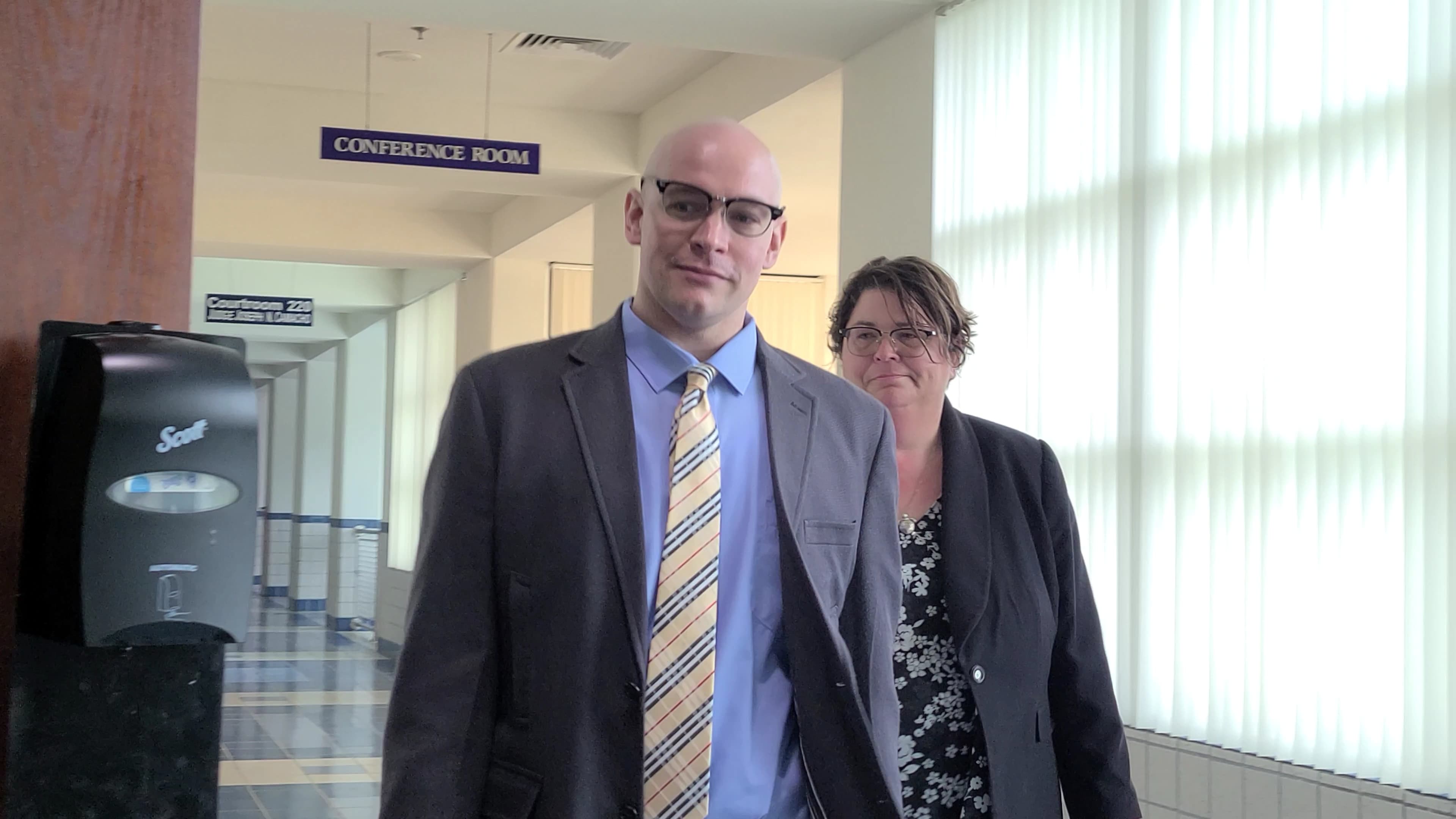
William Abraczinkas walks with his defense attorney Katie Comstock to the court room of his jury trial in NMI Superior Court earlier this month.
-CHRYSTAL MARINO