FAA accepts Star Marianas’ complaint vs. CPA
The Federal Aviation Administration has accepted Star Marianas Air, Inc.’s informal complaint alleging that the Commonwealth Ports Authority is in violation of federal grant obligations.
Last week, FAA compliance program manager Gabriel Mahn responded to the letter Star Marianas sent out last Sept. 11, calling for an immediate investigation into the CPA’s fee-setting practices, its use of the Letter of Authorization process, and its “clear violations” of Grant Assurances.
In his letter, Mahn explains that before providing federal assistance for airport development, the FAA must receive certain assurances from the airport sponsor, in this case CPA.
Upon acceptance of federal financial assistance, such as grants under the Airport Improvement Program or the Bipartisan Infrastructure Law, Mahn said these assurances become a binding contractual obligation between the airport sponsor and the federal government.
“We understand that there have been previous allegations concerning rates and charges between Star Marianas Air, Inc. and CPA that have resulted in agency dismissals. Some of these include the Part 16 and the Part 13 complaint that concluded with our dismissal letter of February 27, 2023,” said Mahn.
Accepting Star Marianas’ informal complaint, Mahn said based on the information provided, the FAA believes additional details are needed to determine if the CPA is complying with its federal grant obligations in light of allegations of discriminatory fee practices and rate base methodology.
“You raised questions about the CPA regulations, and we will consult with the CPA for legal clarification. However, we will not pursue claims under the International Civil Aviation Organization (ICAO) Annexes, Standards and Recommended Practices (SARPs), or other ICAO guidance. The United States, as a member state, through the FAA, has established and enforces its own laws, policies, and mechanisms. Nonetheless, before we proceed, we request that you provide additional information concerning your allegations within 30 days from the date of this letter,” said Mahn.
The information sought are a court ruling that substantiates SMA’s concerns about the CPA’s lack of transparency and regulatory adherence, and specific details and financial breakdown that SMA is requesting in regards to its lack of fee transparency concerns.
“You allege that in February 2024, the Superior Court of the Northern Mariana Islands ruled in favor of Star Marianas Air (SMA), highlighting the CPA’s failure to provide required budgets and adjust fees based on actual costs for 13 years. Despite this, the CPA continues to refuse detailed fee breakdowns and annual reconciliations since 2021, showing a pattern of noncompliance. Please provide copies of the court ruling that substantiates SMA’s concerns about the CPA’s lack of transparency and regulatory adherence,” said Mahn.
“Despite multiple requests, [SMA alleges that] the CPA has refused to provide a transparent breakdown of fees, preventing SMA from determining if the charges are fair, reasonable, or compliant with federal law, or otherwise violating FAA regulations. Please clarify the specific details and financial breakdown that SMA is requesting. Additionally, specify which aspects of CPA financials are of concern and explain how these concerns constitute a violation of the airport rates and charges or airport revenues policies or other relevant regulations or industry standards,” Mahn added.
As of yesterday, Star Marianas has responded to Mahn’s letter with information requested by the FAA.
Previously, Star Marianas board chair Robert Christian sent a letter to then CPA board chair Jose Ayuyu informing the agency that Star Marianas will no longer be tolerating its “scheme to bypass federal fee setting regulations” by “coercing airlines into compliance with non-compensatory fees.”
“I am writing to formally and unequivocally object to the unethical and coercive tactics employed by the CPA under the Commonwealth of the Northern Mariana Islands Administrative Code Title 40, Subchapter 40-10.1: Airport Rules and Regulations (NMIAC 40-10.1). It is abundantly clear that the CPA, in coordination with its legal counsel and consultants, has engaged in a deliberate scheme to bypass federal fee setting regulations, coerce airlines into compliance with non-compensatory fees, and subvert the principles of fairness mandated by the Federal Aviation Administration. This egregious behavior cannot and will not be tolerated,” he said.
Christian informed Ayuyu that Star Marianas intends to file a formal complaint with the FAA and will be demanding an investigation into CPA’s fee-setting practices.
“We will be filing a formal complaint with the FAA, calling for an immediate investigation into the CPA’s fee-setting practices, its use of the Letter of Authorization process, and its clear violations of Grant Assurances 22 and 24. The FAA has the authority to launch a comprehensive investigation into these practices,” he said.
Christian adds that Star Marianas will be urging the FAA to take corrective action to include sanctions and penalties.
“We will be urging the FAA to take corrective action, including but not limited to: the invalidation of NMIAC 40-10.1, the imposition of penalties or sanctions on the CPA for its abusive fee-setting practices, and a requirement that the CPA return to a transparent, compensatory fee model that complies with FAA standards,” he said.
In his letter, Christian explains that CPA’s requirement that airlines must accept all CPA rules and regulations, including the fee setting methodology, upon issuance of a Letter of Authorization, is a blatant act of coercion designed to eliminate any opportunity for airlines to negotiate or challenge its terms.
By linking operational access to this acceptance, Christian said, CPA has created a scenario in which airlines are left with no choice but to accept CPA’s demands or risk losing access to critical airport infrastructure.
“This is not only coercive but represents an abuse of regulatory power and authority. FAA Order 5190.6B, Chapter 18, explicitly mandates that non-compensatory fee-setting models must be mutually agreed upon. The CPA’s approach, which forces airlines to accept terms under duress, flagrantly violates this requirement. CPA’s insistence that airlines automatically accept these terms upon receipt of the LOA, without any opportunity for review, negotiation, or objection, is nothing short of a violation of the FAA’s regulatory framework,” he said.
In addition, Christian claims CPA, its legal counsel, and its outside consultants are “colluding” to impose a fee structure that not only circumvents federal regulations but also serves their mutual financial interests at the expense of the airlines.
“The issuance of a rate book that lacks transparency and bundles arbitrary costs, combined with the unilateral imposition of terms through the LOA, is clear evidence of a coordinated effort to force airlines into accepting inflated and unjustified fees. CPA’s consultants, who have consistently provided flawed and misleading advice under the guise of ‘industry standards,’ are complicit in this effort. Their role in crafting a rate book that is deliberately opaque and lacking in detail further supports the conclusion that this is a calculated effort to obscure the true costs being imposed on airlines. Moreover, the fact that CPA’s legal counsel has facilitated this process by drafting and enforcing regulations like NMIAC 40-10.1 only underscores the degree to which this collusion has been institutionalized,” he said.
Furthermore, Star Marianas claims that CPA’s actions represent clear violations of several FAA regulations, specifically Grant Assurance 22: economic nondiscrimination, Grant Assurance 24: fee and rental structure, and FAA order 5190.6B.
For Grant Assurance 22: economic nondiscrimination, Christian claims the CPA’s fee-setting process (which he alleges forces airlines into accepting non-negotiable terms) is a violation of this assurance as it requires that all airport users be treated fairly and without discrimination.
“CPA’s conduct creates a two-tiered system: One where the CPA dictates the terms, and another where airlines have no recourse but to comply or face operational restrictions,” he said.
As to Grant Assurance 24: fee and rental structure Christian explains that the FAA mandates that airport fees must be compensatory and tied to the actual costs incurred by the airport.
However, Star Claims that CPA’s rate book is filled with inflated charges and bundled costs for services airlines may not even use, and this flies in the face of this requirement.
“This is not only a breach of FAA rules but a deliberate attempt to extort airlines through hidden charges and unjustified fees.
Lastly, touching on FAA Order 5190.6B, Christian claims that the CPA’s systematic effort to “force airlines into accepting its non-compensatory fee structure” without mutual agreement or transparency is a direct violation of this FAA order.
“The requirement for mutual consent is not optional, and the CPA’s use of the LOA process to impose terms without negotiation shows a blatant disregard for federal oversight and accountability,” he said.
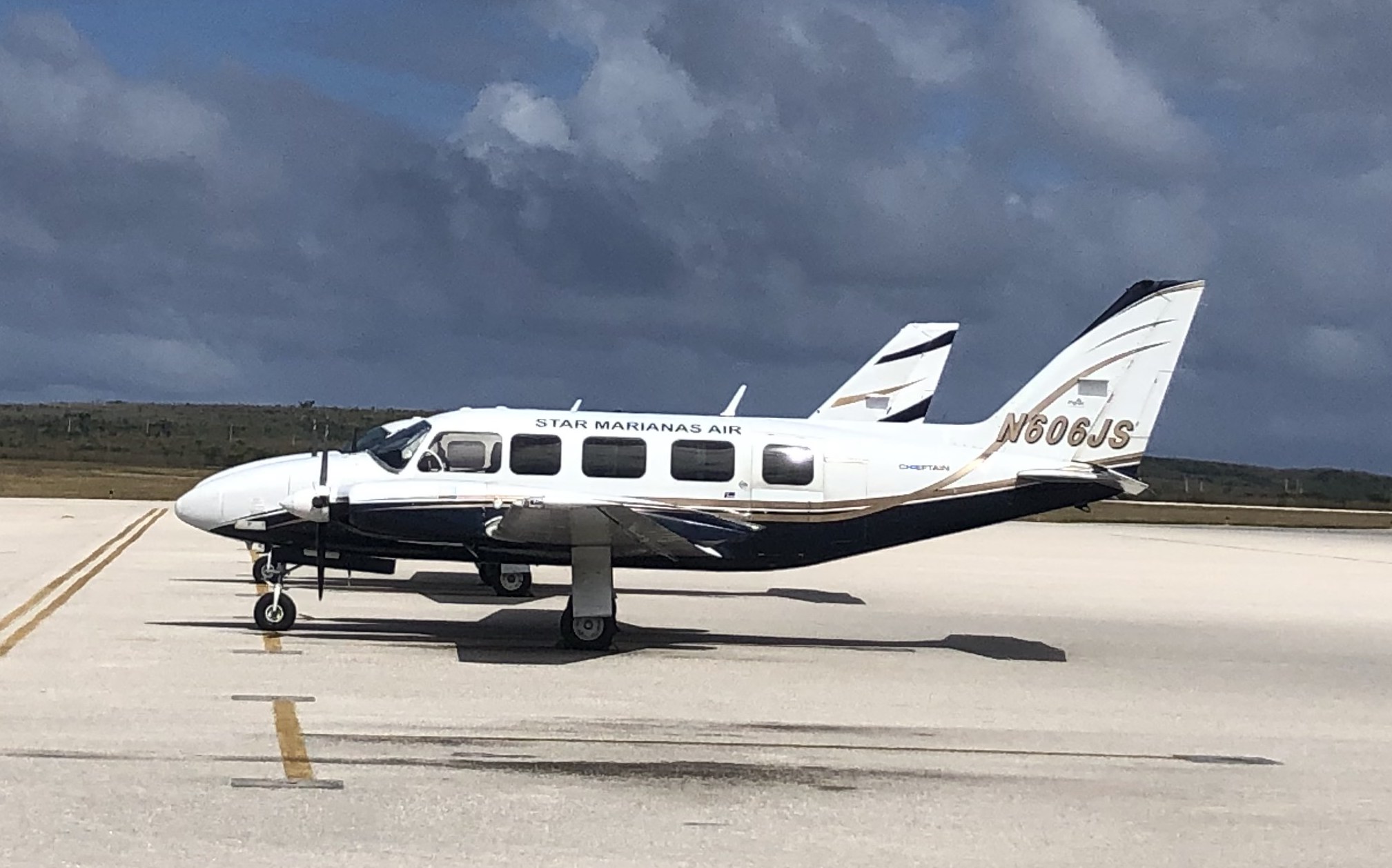
A file photo of one of the planes of Star Marianas Air, Inc.
-KIMBERLY ESMORES