High court denies motion for rehearing on lawsuit vs. cockfighting ban
The United States Court of Appeals for the Ninth Circuit has unanimously decided to deny the request of Andrew Sablan Salas for a rehearing in his suit against the national ban on cockfighting.
Last week, the United States Court of Appeals for the Ninth Circuit officially issued an order denying appellant Salas’ petition for rehearing.
According to the lawsuit, the panel of Ninth Circuit judges unanimously voted to deny Salas’ request.
“Judge Milan Smith and Judge Lucy Koh have voted to deny the petition for rehearing en banc. Judge Richard Paez has recommended that the petition for rehearing on banc be granted. The full court has been advised of the petition for rehearing en banc, and no judge has requested a vote on whether to rehear the matter en banc. The petitions for rehearing and rehearing en banc are denied,” said the order.
Last September, the Ninth Circuit affirmed the district court’s dismissal of Salas’ complaint alleging that the Covenant to Establish a Commonwealth of the Northern Mariana Islands in Political Union with the United States of America precludes the application to the CNMI of a federal cockfighting prohibition.
According to the judges’ ruling, an agreement establishing the Commonwealth of the Northern Mariana Islands and its relationship to the United States means that a ban on cockfighting is legal under federal law in the territory, despite a proponent claiming the ban intrudes on residents’ right to self-governance.
Salas, at one time a House representative for the Commonwealth, called cockfighting an important cultural and political activity throughout the islands that had been wrongfully prohibited by the Agriculture Improvement Act—signed into law by President Donald Trump in 2018—and goes against the covenant that allows the territory a unique level of self-governance.
Writing for the panel, U.S. Circuit Judge Lucy H. Koh, a Joe Biden appointee, wrote in the ruling that “Congress is not precluded from passing legislation affecting the internal affairs of the CNMI. Rather, a court must ‘balance the federal interest to be served by the legislation at issue against the degree of intrusion into the internal affairs of the CNMI.’”
Based on a section of the covenant that establishes laws in effect in the U.S. in Jan. 9, 1978 when Northern Mariana Islands’ covenant was passed, Koh said the federal government’s interests in animal welfare and controlling the spread of avian flu outweighs any degree of intrusion into the territory’s internal affairs.
1966’s Animal Welfare Act was amended in 1976 to ban interstate commerce involving animal fights, so the act is still applicable to the territory under the 1978 covenant, she wrote.
Part of the Agriculture Improvement Act banned all forms of animal fighting throughout the 50 states and its territories in 2018. As cockfighting had already been outlawed in all states by 2008, Salas said the act targeted the territories.
A federal judge dismissed the case in November 2022, finding federal interests in animal welfare and interstate commerce outweighed intrusion on the commonwealth’s internal affairs. Salas then appealed to the Ninth Circuit.
The Commonwealth’s self-governance was a concern for U.S. Circuit Judge Richard A. Paez, who ultimately concurred with the other judges that the ban on cockfighting does not intrude on the internal affairs of the territory, but disagreed with the application of the section of the covenant they used in the ruling.
One of the guiding principles of the covenant is the right to self-governance, the Bill Clinton appointee said, and by using a different section in the ruling, it allowed some legislation to “escape the reach of” a section of the covenant that determines the applicability of laws enacted after January 9, 1978.
In this case, Paez said he would interpret any ambiguity in the covenant “in favor of the CNMI and its people,” and “ensure that its provisions “reaches all federal ‘legislation,’ including subsequent amendments to laws in existence on January 9, 1978” which would further protect the right to self-governance.
“To close, when the United States and the people of the Northern Mariana Islands came together to ratify the covenant, they enshrined in that document the CNMI’s fundamental right to self-government,” Paez wrote. “We are faced here with the question of just how committed we are to upholding that promise,” Paez wrote.
However, Paez still found that Salas failed to demonstrate that the Animal Welfare Act and the 2018 ban on cockfighting intruded on the affairs of the Northern Mariana Islands.
The Ninth Circuit panel was rounded out by George W. Bush appointee U.S. Circuit Judge Milan D. Smith Jr.
Salas had also argued that the Animal Welfare Act should have also exempted Guam, another U.S. territory, from the law’s prohibition on cockfighting, and that the 2018 amendment to the law was motivated by Congress’ subjective moral objections to the practice. Koh disagreed that the law was not applicable to Guam and therefore not applicable to the commonwealth.
Because Guam as a U.S. territory falls under the definition of a “state,” “a statute that references the United States and its territories and possessions is a strong indication that it is meant to apply in the CNMI,” Koh wrote.
She also added that past precedent had already established the ban was also legal in Guam. In 2020, a federal court in Guam denied a man’s motion seeking an injunction to prevent the government from enforcing a ban on cockfighting, finding that “nowhere in the ‘Bill of Rights’ does it give plaintiffs the right to cockfighting.” In 2021, the Ninth Circuit affirmed the lower court’s ruling.
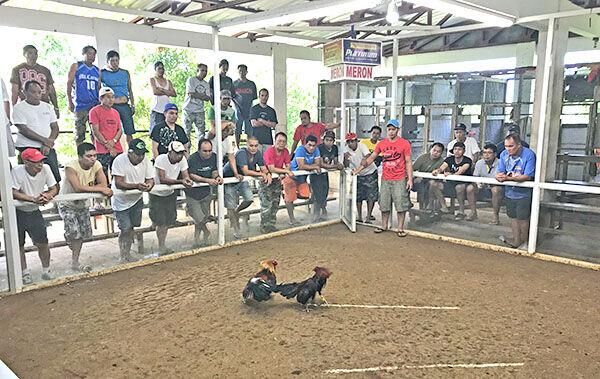
File photo of the old local cockfighting arena along As Lito Drive during a cockfighting derby.
-KIMBERLY ESMORES