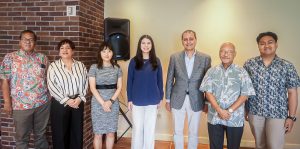
‘We shouldn’t shy away from markets that can easily be tapped into’
Senate President Edith DeLeon Guerrero (D-Saipan) says although diversification is important, due to the current economic crisis, she believes the CNMI shouldn’t shy away from accessible markets like China.
Over a week ago, the Saipan Chamber of Commerce held its 2nd Annual Economic Forum where it was discussed that the CNMI needs at least 500,000 tourist arrivals this year to stay afloat. However, based on panelist presentations, the forecast for this year is about 275,000 arrivals (far from the 500,000 needed just to break even).
Because of this, CNMI stakeholders continue to push for an exemption to the current China-U.S. flight cap in hopes of bringing back the China market (which previously made up over 40% of the CNMI’s tourist industry).
Meanwhile, Gov. Arnold I. Palacios has released a statement reiterating his stance on pivoting away from the CNMI’s dependence on China citing geopolitical issues and further diversifying the CNMI’s tourism markets.
In an interview with DeLeon Guerrero, she states that because the number of tourist arrivals are far from the needed 500,000 arrivals to keep the CNMI economy in that kind of “safe zone,” any market that can bring in tourists should be appreciated.
“The Chinese market isn’t new to us, they’ve been here before, and it’s a faster way to attract tourists to bring in necessary revenue for the Commonwealth to gain strong footing while other markets are being developed,” she said.
However, DeLeon Guerrero adds that diversification is also crucial as to not be completely dependent on one or a few source markets.
“Like investing, you don’t want to put all your eggs in one basket, so diversification is very important. Like that, market diversification in the CNMI is very important. But again, with the way the numbers are looking right now, we are seeing that we need much more robust numbers coming in. So, if it’s any market that we can easily tap into, that’s not a new market for the Commonwealth, then I don’t think we should shy away from that while we are developing other markets to attract tourists that we need. Right now, we all know what we need is airlines and we need tourists. It doesn’t matter what country they come from, as long as they’re allowed to enter the United States, I think we should be embracing that,” she said.
In his presentation during the 2nd Annual Economic Forum over a week ago, Joshua Wise explains that fiscal year 2017 was the last year the CNMI was on track for a healthy and sustainable tourism industry with over 663,000 visitors and nearly 5,600 flights from three major markets.
However, Wise said that as of this year and last, the CNMI is far from 2017 numbers with over 215,000 arrivals last year and a forecasted 300,000 arrivals this year.
“That’s absolutely not enough. We need at least 500,000 arrivals to break even. This forecast is a 54% loss compared to arrivals in 2017. Hotel occupancy also follows arrivals. We went from 90.89% in 2017 to 37.63% in 2023. Hotel occupancy of 80% is what hotels need to make a profit but 70% is what we need just breakeven. So, at 37% occupancy, which takes into account only HANMI members, is a massive loss. When we take into account the entire island’s room inventory from non-HANMI members like guest houses, AirBnbs, our best occupancy we can achieve is just over 25%. This is an over 71% loss compared to our occupancy in 2017,” he said.
Wise explains that the significant drop in arrivals is a result of less flights.
“Less flights mean less visitors. In 2017, the CNMI received 5,597 flights but when compared to last fiscal year, the CNMI only had 1,799. that’s a 67.86% loss in flights. Meanwhile, in 2017, the CNMI had 12 airline carriers but in 2023, there are only four,” he said.
Wise said with the CNMI’s current flights, the maximum number of tourist arrivals is about 270,000 which is nowhere near the 500,000 needed to “break even.”
“The Korea market is already saturated, the Japan market is struggling with a record-low yen, and HK Airlines can only achieve 5% of China 2017 arrival. Bottom line, the current conditions are not stable,” he said.
Palacios, for his part, issued his own statement yesterday saying though he appreciates the recent efforts by the Saipan Chamber of Commerce to gather local businesses and decision-makers to put forth ideas to accelerate the Commonwealth’s economic recovery, he is disappointed by the narrative that continues to be pushed that the People’s Republic of China is the only answer to the CNMI’s current economic struggles.
“This narrative ignores the geopolitical realities in which we live and which I as governor cannot so easily dismiss. It ignores the fraught adversarial relationship between our nation and the PRC, and the fact that the Mariana Islands sit smack in the middle of a brewing conflict in the Indo-Pacific. It ignores lessons we should have learned from our own history. In the CNMI, our overdependence on Chinese-backed investment runs deep and goes back decades: from poker to the garment industry, tourism, and casino gaming. These investments often perpetuated dependence, so that even when those industries proved detrimental—whether to the social fabric, the environment, or national security—many of our business and political leaders were willing to look the other way. And it was hard to imagine alternatives. Overdependence makes us vulnerable—to external shocks as well as political and economic coercion by malicious foreign actors. Public corruption and financial recklessness have also made us vulnerable,” he said.

Edith E. DeLeon Guerrero