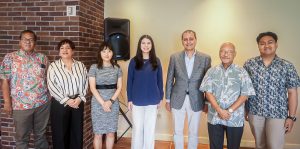
‘A lot of multi-million CIP projects coming our way’
Capital Improvement Program administrator Elizabeth S. Balajadia said a lot of multi-million-dollar CIP projects are coming to the CNMI.
Speaking at a press briefing last week, Balajadia said creating a lot of the capital improvement projects are ongoing whether people see it out there or not.
She said they have funding from the Office of Insular Affairs, Economic Development Administration, and U.S. Environmental Protection Agency.
“Even the smallest shutter project under the FEMA [Federal Emergency Management Agency], you know, protects a lot of our lives here in the community,” said Balajadia, who is also the acting director for the Office of Planning and Development.
She also pointed out that they have renovation projects for public facilities.
Balajadia said under the EPA, they have the $56-million federal Additional Supplemental Appropriation for Disaster Relief Act (ASADRA) funds that are appropriated related to disaster recovery in the CNMI.
She said ASADRA has funded the creation of Marpi Landfill Cell 2.
Balajadia said they are also doing the comprehensive Solid Waste Plan in order for the CNMI to avail of another $32 million worth of projects.
“So, there’s a lot of, you know, positive and there’s a lot of actions out there. It’s not just Beach Road,” she said.
Regarding the 702 Covenant-funded projects on Tinian and Rota, Balajadia said they are still working on the projects and in fact their CIP Office has hired a private consultant to do the environmental assessment for those two projects.
Balajadia’s office administers the 702 Covenant funding, which provides Capital Improvement Program money for Saipan, Tinian, and Rota.
For Tinian, their proposed projects are to provide a waterline and power lines for the West San Jose subdivision. For Rota, it’s the duty water line that connects to the homestead by the airport.
Balajadia said she explained during a recent joint meeting of the Senate Fiscal Affairs Committee and Senate Resources, Economic Development and Programs, and Gaming Committee, that the Office of Insular Affairs requires them to do the National Environmental Policy Act (NEPA) before any money is spent.
She said because the projects on Tinian and Rota require water lines and power lines,” it is not what they call a categorical exclusion.”
“What it is that we need to make more of an environmental assessment which it just means more time-consuming,” Balajadia said.

Elizabeth S. Balajadia