Another 6 years national accreditation for PSS
The Public School System’s national accreditation was reaffirmed for another six years by the global accreditation arm, Cognia Accreditation.
This year also marks the eleventh year for the school district to transition from a school-based to a multi-school, community-wide assessment, and review process.
During the School Year 2013-2014, PSS pioneered system-wide accreditation in the Pacific region. Cognia Accreditation’s predecessor, AdvancEd, declared that PSS is the first district to achieve this feat among island entities and should serve as “a model in the (Pacific) region” for other entities in pursuing a system-wide review process.
Education Commissioner Dr. Lawrence F. Camacho praised the entire PSS community and its stakeholders for this distinction.
Cognia Accreditation announced PSS reaffirmation (renewal) of accreditation for six years early this month. PSS’ new six-year term of accreditation will start from May 2024 to June 2030. All 20 schools in the Public School System and the Head Start program received their certificate of accreditation with an expiration date of June 2030.
“This is a validation of our work over the years on how we hold ourselves to a much higher standard, and of the level of effectiveness of our PSS as an institution of learning. I extend my congratulations to everyone—from our policymakers to classroom teachers and school personnel, students, to central office staff, and all of our stakeholders and supporters—for this accomplishment,” said Camacho.
He added, “What this means is we have to continue the work that we do, including strategies that help and connect our children and provide optimum and quality learning opportunities.”
According to Camacho, Cognia Accreditation’s reaffirmation of PSS’ accreditation “provides a nationally recognized mark of quality for our school district.”
“Being able to maintain this distinction for 11 years demonstrates to our community our commitment to excellence, our openness to review and feedback, and our desire to be the best we can be on behalf of the students we serve,” the education chief added.
Throughout its more than 125 years of service, Cognia, formerly AdvancED, has globally recognized schools that meet rigorous standards focused on productive learning environments, equitable resource allocation for the needs of learners, and effective leadership. Earning accreditation from the Cognia Global Accreditation Commission is a recognition that the school meets Cognia Performance Standards and maintains a commitment to continuous improvement. To earn Cognia accreditation, a school also must implement a continuous process of improvement and submit to external review. Schools in good standing can maintain their accreditation for a six-year term.
‘High standards’
“The CNMI Public School System has demonstrated that it has continually met high standards and made progress on key indicators that impact student learning. Maintaining their accredited status for 25 years highlights a commitment to the quality and improvement of the education provided,” said Dr. Mark A. Elgart, president and CEO of Cognia.
Cognia Accreditation is a rigorous process.
Cognia said the process in re-evaluating PSS was guided by evidence and was centered on four areas or “Key Characteristics” : 1) culture of learning; 2) leadership for learning; 3) engagement of learning, and 4) growth in learning.
“The findings are aligned to research-based criteria designed to improve student learning and organizational effectiveness,” said Elgart.
In PSS’ “Culture of Learning,” Cognia said “learning can be best seen through the system’s holistic approach towards learning and its alignment to the vision, mission, and values of the CNMI Public School System.”
Cognia said interviews and documentation indicate that “stakeholders at various levels are involved, engaged, and felt that they were able to contribute to the process”.
“It was clear from interviews that the whole child and the learner’s wellbeing are at the heart of the (CNMI PSS) and are the principles that guide the system,” Cognia said. “(S)tudents consistently said throughout the interviews that teachers, counselors, leaders, and community members were both supportive and caring about their academics as well as their non-academic needs and interests,” the accreditation findings said.
In the “Leadership of Learning” area for PSS, Cognia took particular notice of how the CNMI Board of Education “serve the citizens of the CNMI Public School System well” by understanding their roles and responsibilities and ensuring that all policies of the district are regularly updated and communicated.
“The board members are dedicated and hardworking community members who hold themselves accountable to the stakeholders of (the CNMI PSS),” Cognia said.
In the third evaluation criteria, “Engagement of Learning,” Cognia pointed out that, based on interviews and documentation, it found evidence that “engagement of learning is centered on student’s engagement and the rigor to challenge learners’ abilities through caring, family-oriented staff committed to learner success.”
“In interviews with students and staff, the team observed that instruction was highly engaging, and expectations were rigorous. Engagement at these levels leads learners to succeed in many different curricula they chose,” the findings said.
The fourth review area, “Growth in Learning” of PSS, Cognia said the school district “best exemplified this through diverse, thorough, and comprehensive set of program offerings…to further its learners’ and staff’s wellbeing.”
In return, the program offering provides “a plethora of data sets and affords leaders to have a variety of data sources to make decisions for the wellbeing of learners and their staff.”
“Teacher and student interviews confirmed that leaders regularly demonstrate this and can provide insightful data to their teams to support their staff in making impactful decisions for learners,” Cognia affirmed in its findings.
History
PSS began looking at the accreditation process as a way to improve all public schools on Saipan, Tinian, and Rota nearly 30 years ago.
In 1994, it was Marianas High School that became the first school to get accreditation, and it was through the Accrediting Commission for Schools, Western Association of Schools and Colleges.
The CNMI Board of Education eventually decided to ask WASC to also review all other public schools in the CNMI.
By 1997, WASC assessment included both the public school’s physical facilities and curriculum.
Before, the accreditation was just descriptive. It just describes what WASC saw in the school that it visited.
But since 1997, WASC has been looking into what the students are really learning, focusing on learning and improvements and where school wants to go from there.
This continued on until 2013-2014, when PSS made a giant leap by pushing for system-wide/district-wide accreditation, by partnering with AdvancED, which eventually became Cognia.
PSS became the first in the Pacific region to receive a full six-year accreditation in its first year in 2014—and, once again, the first school district in the Pacific to achieve a national accreditation reaffirmation, in 2024. (PR)

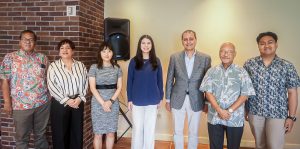
The Public School System’s school principals from Rota, Tinian, and Saipan, program managers, and program coordinators pose with Education Commissioner Dr. Lawrence F. Camacho, center.
-PSS