Carter: CNMI is a success story
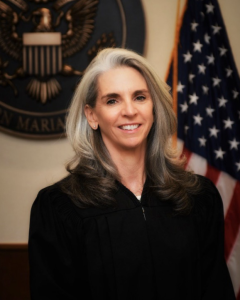
Speaking of the progress made by the Commonwealth Utilities Corp. in complying with court-mandated stipulated orders, U.S. District Court for the NMI designated judge David O. Carter said the CNMI is a success story and the improvements it has made have become a model to follow for other states.
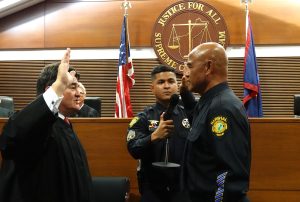
Carter, who oversees the “stipulated orders” regarding the CNMI’s issues with drinking water, wastewater, and oil, along with representatives from the U.S Environmental Protection Agency and the Department of Justice, are visiting Saipan for the week. Part of their visit was to join the ribbon-cutting ceremony unveiling the Sadog Tasi Wastewater Treatment plant’s new clarifier.
Carter said the CNMI is doing an incredible job in terms of complying with the mandates of Stipulated Order 1 and 2, whose actions in the past few years could be used as a model for other states on “what can be done.”
“My compliments to CUC, [the] CNMI, DOJ, [and] EPA. It’s a good success story. Power plants 1 and 2 [and] Power Plant 4 are operating well, good integrity, backup systems, pipeline is underground now in case a typhoon hits. So, we’re pretty well protected here with redundancy, complimentary of all involved in the process,” he said.
Carter also said the CNMI continues to make progress in terms of its water service, but improvements can still be made.
“With water, we’re making a lot of progress. When we first came here, a lot of folks on the island had two to four hours of running water due to bursting pipes, no regulations, water meters that were breaking. Now, we’ve got 24/7 water, we’ve got chlorine to keep the water clean, wastewater plants are operating now with a new clarifier with the output of fluids being a model for the United States. We’re making tremendous progress, but we’ve got more to do. We want to keep the island healthy, the folks healthy, protect our workers, and get more tourists to come to this incredibly beautiful place with incredibly lovely people. Let’s keep building. We’ve got good infrastructure started, but we shouldn’t rest on that. We need to keep improving and keep up with the standards and there’s still a lot of work to do,” he said.
So far, Carter said, the CNMI is in compliance and has completed what needed to be done under SO2.
“We’re now in a situation where we’ve completed SO2. Think of SO2 broadly as your oil and your tanks. When we first came here, the CNMI had one operating tank. There was another tank, Tank 104, that was causing leakage toward the ocean so we put in a berm of 15 feet down and about 500 feet wide to contain the leak to reduce contamination. We don’t have any contamination now. Most importantly, we’ve torn down Tank 104 completely, we’ve torn down Tank 101, and you’ve got Tank 102 and 103, so for the first time the CNMI has redundancy here, meaning in case one tank goes down, we could use another tank. …Even if one tank goes down, you have another so there’s no power shortage,” he said.
Carter added that pursuant to SO2, the CNMI has solidified its infrastructure.
“If there’s a typhoon, there’s cement poles now. Line may go down but its easier to string along lines. It’s not easy to get over 80 telephone poles off the boulevard, which happened during a previous typhoon, making it hard to move. So now, the CNMI’s got good infrastructure. We came here and the oil pipe coming out of the port was overground so we had guards around the clock, seven days a week who had to walk that pipeline just to check for an oil leak. That’s underground now and we’ve protected it so when a typhoon comes, that pipeline isn’t going to go down. The CNMI’s infrastructure is now very strong, very solid with oil,” he said.
As for SO1, which deals with the CNMI’s water, Carter said the CNMI still has some work to do in terms of increasing water quality.
“With water, it’s been a constant struggle. Folks here didn’t have constant running water. Areas like Dan Dan, Koblerville, had about four to seven hours of running water each day. Now, the entire island has water 24/7 and we’re trying to increase the quality of the water because we’ve got a lot of minerals here. …We’ve been getting rid of all the contamination from the airports caused years ago by historic folks who contaminated a lot of those wells down there. We’re making progress here and these folks at CUC really worked hard. This clarifier was a complete mess and they kept it going for four years. My compliments. But we’ve got work to do, though, so there’s no resting yet,” he said.
According to Saipan Tribune archives, the two stipulated orders directed CUC to implement certain projects within a specific time.
SO1 and 2 are mandates issued by the U.S. District Court for the NMI ordering CUC to address its issues with drinking water, wastewater, and oil. The court issued the two orders in March 2009 through January 2020.
SO 1 focused on requiring CUC to provide safe drinking water to residents on a 24-hour basis, maintaining adequate chlorine supplies, and safely treating and discharging wastewater.
SO 2 focused on oil issues such as requiring CUC to repair and replace oil storage units and operation infrastructure, manage tank and pipeline facilities and handle storm water runoff.

U.S. District Court Judge David Carter, left, and Lt. Gov. David Apatang pose for a photo.
-KIMBERLY B. ESMORES