Conversation highlights inequity in US territories
The Northern Marianas College and the non-profit Right to Democracy joined forces last Feb. 19, 2024, to host a conversation on democracy, equity, and self-determination in U.S. territories at the American Memorial Park Visitor Center Theater, with the speakers highlighting the discriminatory nature of how citizens in the territories are treated compared to the rest of the nation.
Moderated by William J. Fife, who is an associate professor at Northern Marianas College and a former Public School System history teacher, the panel of advocates was made up of Charles V. Ala’ilima, co-counsel in the Fitisemanu v. United States case (American Samoa); Pamela Colon, co-counsel in the Borja v. Nago case (U.S. Virgin Islands); Neil Weare, co-director, Right to Democracy (Guam); and Kimberlyn King-Hinds, local counsel of the Tinian Women Association et al. v. U.S. Department of the Navy et al. case (CNMI).
Colon shared her experience on how she has always exercised her right to vote in Chicago, Illinois, since turning 18 years old, yet lost that right when she moved to the U.S. Virgin Islands.
It was there where she discovered that the U.S. Virgin Islands citizens did not cast their votes for the U.S. presidential elections and she could not believe that she had lost her right to vote.
It wasn’t until her son turned 15 that it occurred to her that when he turns 18, he would have to register for Selective Service. It woke her up to the circumstances they were in.
“Upon registering, neither he nor I would be able to vote for his commander-in-chief. Neither he nor I will be able to vote for the people who would declare war. Neither he nor I would be able to vote for the people who would fund any war if it were declared,” she said.
That was when Colon decided to take action by visiting the local high schools to inform them that they would deal with the same issues as her son. About 10 years ago, she was asked to be a plaintiff in a case regarding absentee ballots.
In the American Samoa experience, Ala’ilima said being American nationals means “you owe your duties to the United States but the U.S. does not owe that same fidelity back to you.”
He said last Feb. 19’s program is not intended to tell people where to go or what to do, but “to set the stage so that the people can dance on that stage,” and that stage is subject to the U.S. Constitution and its principles.
Weare shared his experience at a summit in New York City, which involved more than 50 community leaders from the five territories. “Common ground came out in a conversation—that so many folks just want to have a say in the decisions that impact their lives,” Weare said, adding that he believes everyone must recognize that there is a problem before someone can act to fix it.
King-Hinds gave the Northern Marianas’ perspective on the issue and agreed with Colon on how it is problematic that U.S. citizens in the territories do not have the ability to vote for the U.S. President.
One of the attendees, Emma Chong, learned from the conversations that the CNMI’s relationship with the U.S. federal government is not obscure, but very particular.
Chong believes that compared to the other U.S. territories, the CNMI has more autonomy, though not by much, yet that comes at a cost such as relinquishing certain powers like having a U.S. delegate that has no vote in Congress.
“I would still fight and advocate for a stronger voice in the White House, but I also think there is not a clear way to go about that, given the CNMI’s relationship with the U.S. Though if we were to proceed with advocacy for a stronger voice, it would have to be through the court systems, devised through lawsuits with our government officials and the community working in tandem under a unified agreement,” she said.
In light of all she’s learned from the conversations, Chong believes that CNMI history should be a two-semester course taught within the Public School System to raise awareness of the fight it took to create today’s CNMI and the rights that its citizens have or do not have.
“I firmly believe we are being misdealt by the federal government in being second-class citizens,” said Chong.

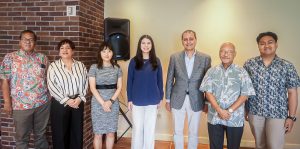
From left, moderator William J. Fife, an associate professor at Northern Marianas College, Charles V. Ala’ilima, co-counsel, Fitisemanu v. United States (American Samoa), Pamela Colon, co-counsel, Borja v. Nago (U.S. Virgin Islands), Neil Weare, co-director, Right to Democracy (Guam), and Kimberlyn King-Hinds, local counsel, Tinian Women Association et al. v. United States Department of the Navy et al. (CNMI).
-JENISHA DUBRALL/