Delegate candidates share thoughts on CW phase out
Second of a multi-part series
The five candidates running for the CNMI delegate seat in the U.S. House of Representatives also answered questions about the CNMI-Only Transitional Worker Program during the Marianas Business Network town hall forum last Wednesday at Tom Yum Restaurant & Karaoke Bar in San Antonio.
CNMI Republican Party bet Kimberlyn King-Hinds responded that there is a need to address workforce stabilization that addresses the CW program that will end in 2029.
She said she’ll be advocating for a policy that addresses the CNMI’s unique economic challenges, business climate, and remote geography. She added that she doesn’t believe in the CW cap due to life in Typhoon Alley and that worker numbers will always change and would need flexibility.
King-Hinds said that large and small business owners are unhappy with the CW application processing times. She also wonders why Guam can provide temporary Labor certifications and the CNMI can’t. She also wants a tailored policy where businesses can have access to workers that can lead to a dynamic business environment.
Jim Rayphand, an independent candidate, said the CNMI needs to ensure data is collected on what the workforce needs are and number of CW workers needed to present compelling case to Washington, D.C. He added that five years is not enough time to end the CW program. He also wants to strengthen the local workforce by ensuring funding is allocated to apprenticeship training for jobs the CWs are currently filling. Rayphand wants to create a workforce partnership plan with neighboring islands such as Palau and the Federation States of Micronesia.
Liana Hofschneider, another independent candidate, shared that from her past experience as an immigration officer, the CNMI will never have a plan to address the end of the CW program. She said it’s un-American to take over immigration from the CNMI without any boots on the ground. Hofschneider also wants a portion of U.S. lottery earnings allocated to the CNMI.
Edwin K. Propst, who is running under the Democratic Party of the NMI, wants to champion Delegate Gregorio Kilili C. Sablan’s (D-MP) House Resolution 560 to take care of long-term workers and investors. He also wants to work with the Saipan Chamber of Commerce and present in Guam a visa specific to Marianas already supported by Guam Gov. Lou Leon Guerrero and Lt. Gov. Josh F. Tenorio. Propst said it is critical to work together with Guam so that both U.S. territories can benefit in a more effective way of recruiting foreign workers.
Another independent candidate, John Oliver Gonzales, said that anything that must be developed or enacted is driven by data and emphasized that data is the cornerstone. He wants to establish a CNMI-only policy which stabilizes source markets for human capital and skilled laborers for tourism and workers to help diversify the economy. Gonzales urged the use of labor data from the last two decades to inform the U.S. delegate for a more customized and more robust legislation before 2029. He also wants the CNMI to balance the need for peace and security in the Info-Pacific region.
The delegate candidates were then asked with Washington, D.C.’s primary focus on defense right now how will they ensure the steady flow of federal dollars to the CNMI?
Hofschneider spoke on the CNMI’s unique relationship with the U.S. and believes federal funding will trickle down to the CNM and promised to funnel money to the islands for higher a standard of living. She said she will work to make the U.S. sympathetic because their past policies have negatively affected the CNMI.
Gonzales said that the CNMI must welcome an economic partnership with the U.S. military in a sustainable way and make it a stable, long-term anchor tenant. He wants to invest in job opportunities for locals and be able to compete for military contracts. Gonzales said the National Defense Authorization Act makes up the bulk of military funding and calls on the U.S. government to revisit market valuation of leased lands and oceans for fair market value. He also wants the federal government to deposit up to 50% of those funds in a reserve account for future generations.
Propst believes in leveraging the geography of the CNMI as the tip of the spear against foreign aggression in its negotiations with the U.S. He also wants to work with partners to secure more funding for the CNMI. He used the Tinian Divert Airfield project as an example of military funding and how quickly Tinian’s economy turned around because of it.
For Rayphand, military and defense activities ensure flow of funds to the CNMI and believes supporting the military leads to more federal funding. He wants to examine which federal grants the CNMI is already a part of and make sure it remains included in them. Rayphand also wants to work with federal partners to address the unique needs of the CNMI in reference to local match needs. He said local match for funds is a barrier and he wants to seek waivers for most match requirements. He also wants to look for new funding for new industries, particularly for agriculture.
King-Hinds mentioned that she dealt with federal partners for 10 years and knows how the actual process works. She said DOD will not spend money when there is no impact and that the CNMI is about to be awarded the America the Beautiful grant for the first time and that this would have less impact on Saipan and Rota. She wants to look to change the rules of the grant so funding will impact all of the CNMI and not just Tinian.
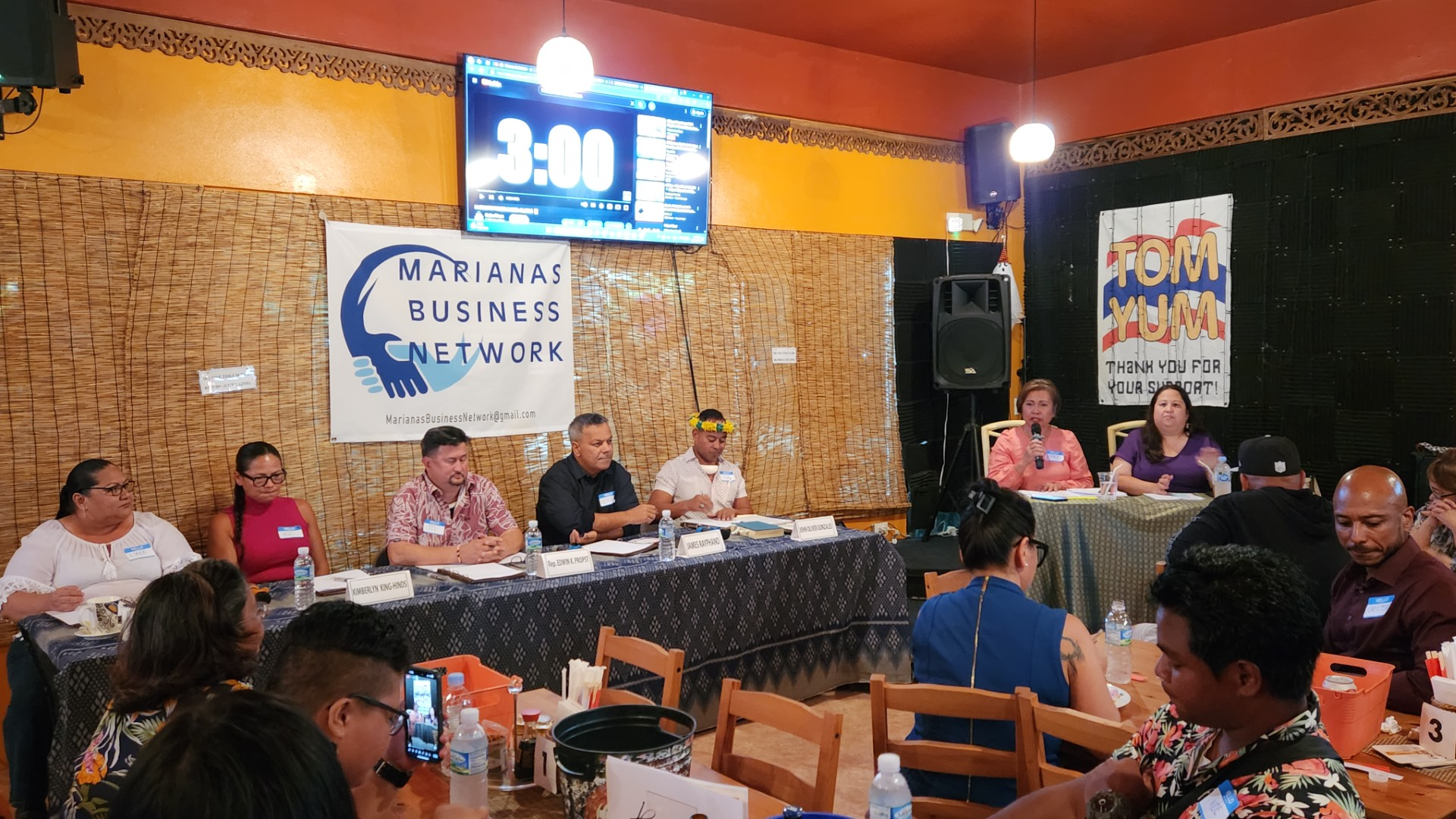
The Marianas Business Network’s town hall forum was held at Tom Yum Restaurant & Karaoke Bar last Wednesday night. On the table, from left, Liana Hofschneider, Kimberlyn King-Hinds, Edwin K. Propst, Jim Rayphand, and John Oliver Gonzales.
-RACQUEL FLOYD