Farrell speaks on start of the Battle of Saipan
Local historian Don Farrell highlighted the strategic importance of Saipan and shared that the Battle of Saipan was a crucial and yet a challenging campaign for the U.S. military during his presentation last June 13 at the American Park Visitors Center.
Farrell, who spoke in the eve of the commemoration of 80 years of peace in the Pacific since the Battle of Saipan and Tinian, began his talk by quoting Admiral Richmond Kelly Turner who said that the Battle of Saipan was a “real nutcracker” as Japan had controlled the Northern Mariana Islands since 1914.
Dozens of community members and visiting guests joined the discussion. During his presentation Farrell focused on the lineup of events that aggravated the Battle of Saipan and Tinian during the Pacific theater of World War II and also highlighted certain key roles Saipan and Tinian played in the Pacific War.
He also gave historical context to history, sharing that during World War I, Japan, as an ally of England, gained control of German territories in the Pacific, including the Northern Mariana Islands. The U.S. pursued imperialism after the Spanish-American War, acquiring territories like the Philippines and Guam.
Farrell shared that the Dec. 7, 1941 attack by Japan was meticulously planned to disable the U.S. Pacific Fleet and stressed the strategic coordination of subsequent attacks in Guam and the Philippines, noting that just three hours after the Pearl Harbor attacks, the Japanese launched a bomb from Saipan’s As Lito airfield to Guam.
After Pearl Harbor, due too massive losses for the U.S. Navy, the U.S. prioritized protecting its lines of communication to Australia, one of its key allies closest to Japan.
Farrell underscored the U.S. shift from isolationism to becoming a global power post-World War I and how Japan’s aggressive expansion in Asia led to inevitable conflict. He explained that Japan’s strategy aimed to force the U.S. into a truce by crippling its military capabilities, but ultimately, the U.S. resolved to continue the fight. “The Battle for Saipan was one of the most difficult, most creative battles the United States ever fought,” said Farrell.
Farrell’s talk provided a comprehensive overview of the historical significance and strategic intricacies of the Battle of Saipan, emphasizing the broader context of U.S. and Japanese military strategies during World War II.
Following the presentation, the media had a couple of minutes of brief conversation with Farrell and he shared the importance of the location of the Northern Mariana Islands and the importance in keeping history alive.
“The young people today in the Marianas need to understand that these islands are strategically located. There’s nothing that anybody can do about that. The reason why wars have occurred here has nothing to do with the people or the islands themselves. It’s their location. And if there’s a larger company, a country, who has the desire, they will come and try to take this island. Or they will try to create a situation that will neutralize this island so that they can be doing what they want to do somewhere else.”
Farrell said that’s why it’s important to understand that you cannot eliminate the concept of war totally.
“War is a reality that nobody likes, but everybody has to learn to deal with. So, what can you do to prepare yourself for it? Get well educated. Take good physical condition of yourselves and participate in your government. Participate in your government both locally and regionally. The more communications we have between people, the less likely we are to have misunderstandings. Most wars develop from misunderstandings,” he shared.
When asked how one can keep history alive amidst a time of misinformation, Farrell doubled down and said that education is always important.
“I think that the only way is to read. And you’re right. The problem with smart phones and internet communications in general, right, is that they are not necessarily factual. They serve somebody’s purpose, usually a monetary purpose. I know, I understand from my own children and as a teacher from my students how much they enjoy that. There are things positive that can be learned off of those machines. But if you want to save the history, you have to learn the history and the only way to do that is to read it. Read it, and then practice it.”
Farrel said that he had been pleased to be able to share history that night. “I’m just very pleased to always have the opportunity to come back and do a little story here and get some good questions.”
Farrell’s presentation was made possible through collaboration with the American Memorial Park, Saipan Mayor’s Office, and Northern Humanities Council. After the presentation, a book signing was held in the foyer of the American Memorial Park’s museum.

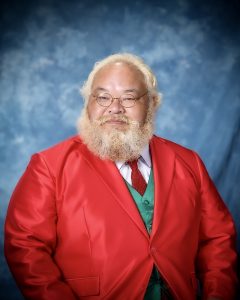
Historian Don Farrell speaks on the events preceding the Battles of Saipan and Tinian and the importance behind the June 15, 1944 invasion last June 13 at the American Memorial Park Visitors Center in Garapan.
-CHRYSTAL MARINO