Kim-Tenorio grateful for voters’ faith in her
CNMI voters resoundingly reaffirmed Superior Court Associate Judge Teresa Kim-Tenorio’s place on the bench, last Tuesday, with an overwhelming 84.21% of ballots cast in favor of her retention.
Out of 11,767 votes, 9,909 supported keeping her in office, while 1,858 opted against it. Kim-Tenorio’s retention secured a “yes” majority across all election precincts on Saipan, Tinian, and Rota, demonstrating what seems to be strong island-wide confidence in her role on the judiciary.
In an interview with Saipan Tribune yesterday Kim-Tenorio shared her gratitude to the community and voters. “I’m very grateful for the community for supporting me and for voting yes to keep me on the bench. So long as I’m here and the people want me to continue as a judge, I will work hard and I will continue to develop new programs and explore new ideas so that it’s beneficial to the community. Also to give the community a different view of the CNMI Drug Court. When people think of court, they think, oh, ‘that’s a place you don’t want to go, that’s a place where bad things happen.’ And I want to change that perception of the courts, that that’s not all we do, that we reunify families, that we help people who have drug addictions or whatnot, that it could be a healing place. And so that’s what I would like to continue doing.”
Looking ahead, Kim-Tenorio shared that she hopes to continue to expand the drug and treatment court to help those affected by drugs, especially when rehabilitating. She also shared that often people see her as the drug court judge.
“So, I think that’s kind of what defines me in a lot of ways as a judge is treatment courts, and that is something that I’m very passionate about. Drug court fell on my lap. It’s not something that I started from the ground up. It was actually started by retired judge [David] Wiseman and he was exploring it and then he retired and he passed the torch on to me and so I researched it and got it off the ground.”
The CNMI Drug Court will turn eight years old in December since its first hearing and through the drug court, Kim-Tenorio realized that her view on the criminal justice system has drastically changed in terms of what works and what doesn’t work.
“My thinking and my focus have really shifted from the traditional criminal justice, the system which is you go to trial or you don’t go to trial, you plea out, you go to jail, you serve your time, you come out, you’re on probation, repeat. My focus is when you sentence someone there are factors that you look at, rehabilitation, incapacitation, retribution, and so forth and so what are we doing? We are incapacitating them when we put them in jail but that’s it, that’s the only thing we’re doing and it’s very important to help these people reintegrate into the community because whether you like it or not, they’re going to do their time and they’re going to come out of jail.”
She continued that at the end of the day, she wants people who are incarcerated when they come out to be ready to reintegrate back to society.
“They need to have an education, they need to have a place to stay, they need to have health care, they need to have a job, they have to be able to support themselves and so through the drug court I found my passion. I found my passion and that’s to rehabilitate folks and to help them be part of our community because drug addiction, trauma, PTSD, anything that causes people to suffer in such a way that they turn to crime could happen to anyone. It could happen to educated folks, it could happen to uneducated folks, it could happen to rich people, poor people, it does not discriminate, and until it happens to someone that you love or someone that you know or someone that you work with, people maybe just think that they’re bad people and I really want to reduce that stigma that they’re bad people.”
Kim-Tenorio said the fact is not all people who end up in drug court are inherently bad.
“They have made bad choices but the bad choices were made because of an underlying issue whether it’s drug addiction, whether it’s trauma, PTSD and also when you know when we talk about drug addiction what I want people to understand is it’s not all meth, right, sometimes people may have had surgery and they were given painkillers….and they get addicted to painkillers, right? So, it’s not always associated with meth or heroin or something illegal, so to speak. So that’s what I would like to continue doing.”
The associate judge also said she would like to continue exploring different treatment courts, particularly interested family treatment court because she also the family court judge.
“As the family court judge, I handle TROs, I handle wardship cases, among other things. But through TROs and through wardship cases, I see a lot of drug use, child neglect, and so forth. In wardship cases, for example, since August of this year until just end of October, I believe I’ve had seven or eight newborn babies born with meth in their system that have come to court. And what I would like to do is start a family treatment court where I can treat the parents but also take care of the babies and other children in the house.”
She added if there are other children in the house and they go to school, she wants to make sure they get to school as well as getting their immunization.
“[I want] to make sure they have clothes. Make sure they go to counseling and understand what’s going on and treatment for mom and dad as well. Because the whole purpose is what’s in the best interest of the children and keeping the family unit together. So that’s something I would like to do. I mean, so that mom and dad don’t then veer off into criminal activities, right?”
She added, “Also in TROs, I see a lot of couples or family members who come to court asking for an order of protection because maybe one person is using drugs and it’s affecting the family. So that’s the direction I would like to go in. Creating more programs to help our community rather than being punitive and punishing and just saying, ‘you know, let’s put them in this place, jail, and forget about them,’ right? So, I want to destigmatize drug use and trauma and PTSD and help the community move more towards healing rather than punishment and being punitive. So that’s what I would like to do, and I’m grateful. “
Kim-Tenorio said currently the CNMI Drug Court boasts an 83% success rate, adding that with 3,400 treatment courts across the nation, a number that’s growing, and treatment courts itself now 44 years old from when it started 1989 in Florida, she feels happy to be a part of that growing family.
“And, again, I thank the people,” said Kim-Tenorio. “I thank the people of the Commonwealth for giving me this opportunity once again to continue serving as a judge in the Superior Court. I’m happy with the democratic process. I’m happy that they’re able to vote yes or no because even when you vote no, it tells me that I can do better, okay, that it gives me an opportunity to reflect and say, what can I do better, what can I do differently so that I can be a better judge and so that I can continue serving our community in a way that’s beneficial for everyone.”
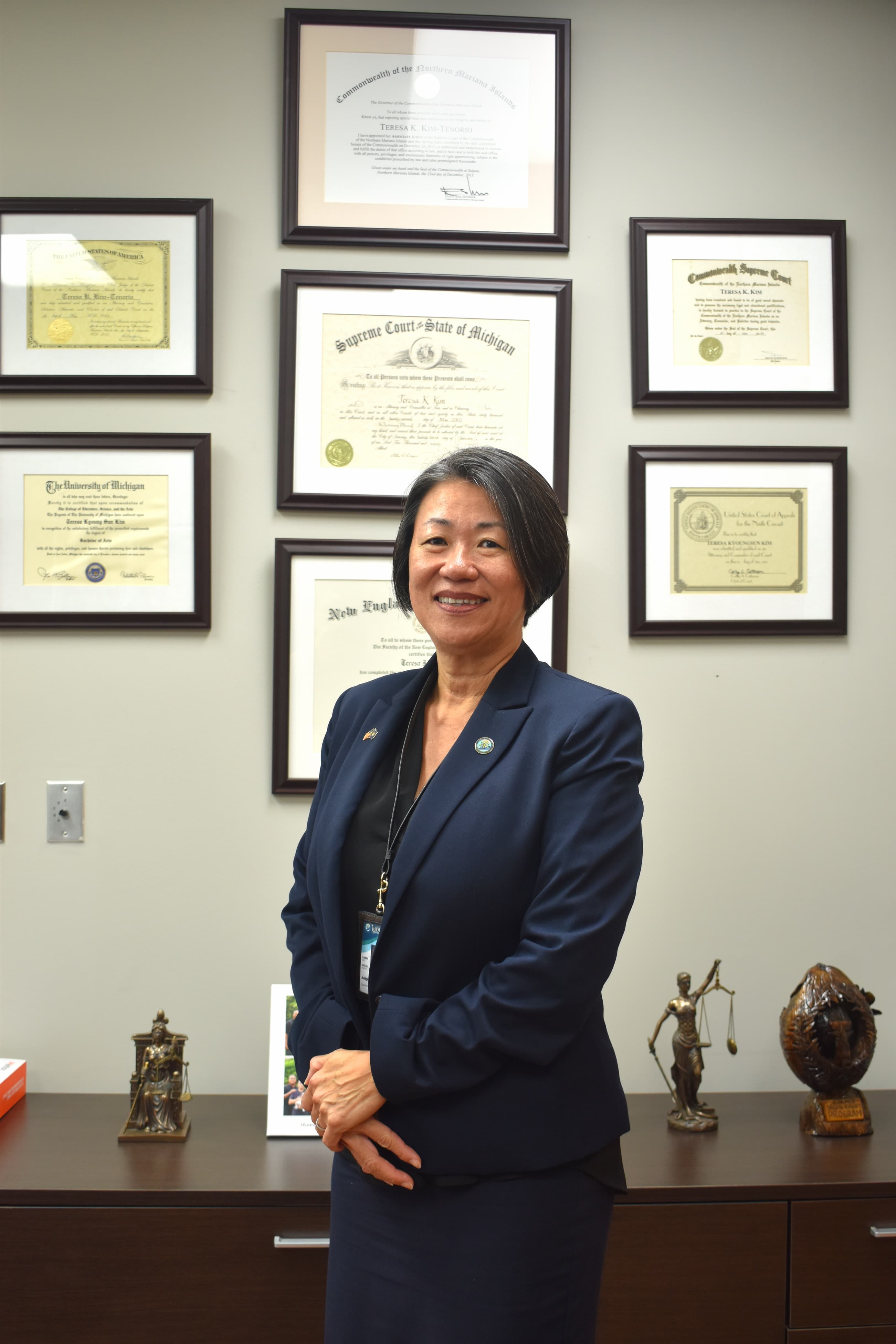
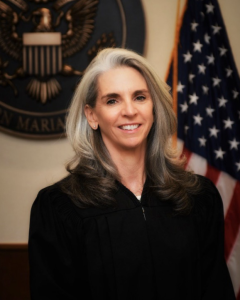
NMI Superior Court Associate Judge Teresa Kim-Tenorio smiles for Saipan Tribune after an interview yesterday afternoon at Guma’ Hustisia in Susupe.
-CHRYSTAL MARINO