Local climate change efforts ramp up
The federal government’s nationwide efforts to combat climate change and how that effort will go down at the CNMI level was the focus of yesterday’s Saipan Chamber of Commerce general membership meeting at the Crowne Plaza Resort Saipan.
Speaking about the new Climate Pollution Reduction Grant Program and her office’s steps to creating a clean energy economy and the CNMI’s first greenhouse gases inventory, CNMI Climate Policy and Program Office special assistant Tina Sablan said the program is actually an offshoot of the federal Inflation Reduction Act in August 2022. Under this grant program, a total of $370 billion had been set aside to address the threats posed by the climate crisis, and drive investments to frontline communities and spur innovation and job creation. One of those frontline communities being the islands, one of which is the CNMI.
Under the act, $5 billion is designated specifically for the Climate Pollution Reduction Program, and $250 million is allocated for climate action planning across states and territories. Sablan said that that includes $500,000 for each of the territories over the course of the four-year grant period.
“[A total of] $4.6 billion is allocated for implementation and this is to carry out the priority climate action projects of communities throughout the nation. Out of that amount, $300 million is set aside just for the territories and the Tribes to compete for,” said Sablan.
Sablan said most frontline communities are more impacted by climate change, even if they do not produce as much greenhouse gases as more developed countries.
“No one is really spared from these threats, but some are more vulnerable and disproportionately impacted than others. And though we contribute so little…to greenhouse gas emissions on a global scale, islands like ours are frontline communities in the climate crisis,” she said.
Sablan said their mission at the CNMI Climate Policy and Planning Program is to address climate change threats and iniquities and reduce the CNMI greenhouse gas emissions and transition the Marianas to a clean energy low carbon economy.
Their main goals, she said, is to achieve significant greenhouse gas reductions by 2030, provide benefits to communities, especially low income and disadvantaged populations; complement other funding sources to maximize greenhouse gases reduction, and pursue innovative measures that can be scaled up and replicated.
“Unlike other territories, the CNMI doesn’t yet have a climate action plan in place and, like all the other territories, we don’t have yet a baseline data or a greenhouse gas inventory like other states and local communities do for how much we are producing in carbon dioxide, methane [and] other emissions across different sectors. We need this data to be able to make informed decisions in the measures that we choose to reduce emissions and make that transition to the clean energy economy,” she said.
The CPRG aims to address these gaps, Sablan said, adding that they are working to develop the CNMI’s first greenhouse gas inventory, and will be gathering data from local partners in the public and private sector.
She said the greenhouse gas inventory may include gases produced by the Commonwealth Utilities Corp.’s diesel generators and power plant, water and wastewater treatment facilities, as well as government generators, the transportation sector, which includes the government fleet and private vehicles, heavy equipment, buses, boats, aviation and shipping and solid waste landfills across the three islands.
She said that the greenhouse gas inventory is key in developing the CNMI Priority Climate Action Plan, which is due on April 1st 2024.
“It requires a lot of stakeholder engagement. “ she said. “We have a lot of plans and more planning is required in the climate pollution reduction program but a plan that just sits on a shelf and nothing is done with is not just costly but useless. And what is so exciting about the climate pollution reduction plan is the emphasis on action. …The funding was just released in September and again it’s $4.3 billion for the general composition and $300 million for the territories and Tribes to compete for.
The estimate is that the award for Tribes and territories will range from $1 million to $25 million, she added.

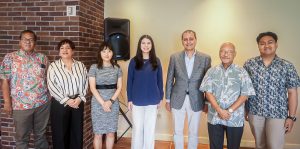
CNMI Climate Policy and Program Office special assistant Tina Sablan was the Saipan Chamber of Commerce general membership meeting guest speaker yesterday at the Crowne Plaza Resort Saipan.
-CHRYSTAL MARINO