McDoulett explains complexity of immigration law and its implications
Immigration lawyer Joey McDoulett outlined the complexities of immigration law in his presentation as guest speaker at the Rotary Club of Saipan meeting last Tuesday at Crowne Plaza Resort Saipan.
McDoulett covered three things about immigration law which includes its complexities, the importance of getting advice from somebody who’s qualified to give it, what the CNMI-Only Transitional Woeker program is right now, where it came from, and what are the prospects for the future of immigration law specifically in the CNMI.
“I’ve already said it a couple of times, immigration law is complicated. People do not believe or understand how complicated it is. It is second only to the tax code. It is even more complicated than the tax code because of how long it is and how many regulations and statutes it covers. It incorporates by reference statutes and regulations from labor and employment, from family law from every state.”
McDoulett explained the involvement of five federal agencies in governing different aspects of immigration law also leads to inconsistencies and complications wherein even basic citizenship is subject to differing interpretations among these agencies.
“Some would think simple concepts like who is a U.S. citizen? They all don’t agree. Probably the one that you would think up first is USCIS, United States Citizenship and Immigration Services, obviously they’re involved in immigration. The Department of State, they’re the only entity that grants visas. USCIS doesn’t have anything to do in granting a visa. So, the Department of State grants visas, Customs & Border Protection, even if you’ve gotten a visa or gotten status granted to you in the United States. Every time that you enter the United States, you are reevaluated for whether or not you’re inadmissible. That applies to a permanent resident. The executive office of Immigration Review is the agency that’s in charge of reviewing any of the decisions made by Immigration and CBP. Finally, the Department of Labor, and that might be the department that you guys are most familiar with, in regard to some of the applications that you deal with, because they are the ones that decide whether the labor certifications are valid.”
Furthermore, McDoulett discussed the unique nature of the CW visa, which is specific to the CNMI and serves labor needs not met by the local population.
“The CW visa status is unique to Saipan. It doesn’t exist anywhere else in the United States and it serves a valid and important purpose and it has since, I guess, the first CW visas were issued in 2011…But it was created in recognition of the fact that we have a desperate need for labor in the CNMI and that the population of the CNMI is not sufficient.”
The immigration lawyer explained the conservative view of Congress regarding immigration benefits and the limitations placed on the CW program. He also mentioned the difficulty of obtaining CW visas and the importance of employers exploring options for hiring.
“Congress has always had this very kind of conservative view of immigration that they want to control it. They don’t want immigration benefits to be issued to people outside of permanent residents and U.S. citizens… They tried to limit it, so they put a cut-off date on it, and the cutoff date has been extended to December 2029.”
He expressed uncertainty about the future of the CW program and discussed other options available such as an H1B visa based on professional skills or a temporary non-skilled labor visa which is more expensive and more difficult to acquire labor certificates.
“Now, the complaints that all employers have is we tried, but we still can’t meet our needs. I don’t know if Congress is going to listen. I really don’t. I don’t know if in the next four years, if our ability to expand CW or push it past December 2029 is going to be available to us,” he said.
McDoulett emphasized the responsibilities in reporting CW visa employees, and he warned against employers giving legal advice to employees and shared an example of the John Pickle Company in Tulsa, Oklahoma that faced legal consequences for doing so.
He stresses the importance of maintaining a clear separation between employer responsibilities and employee legal issues and he advised employers to refer employees to qualified legal professionals for immigration-related questions.
Furthermore, he underscored the importance of truthfulness in immigration applications to avoid legal complications and potential deportation.
He emphasized the need for thorough and accurate information in immigration applications to avoid future legal issues.
The presentation ended with McDoulett thanking the audience and reiterating the importance of seeking qualified legal advice for legal matters.
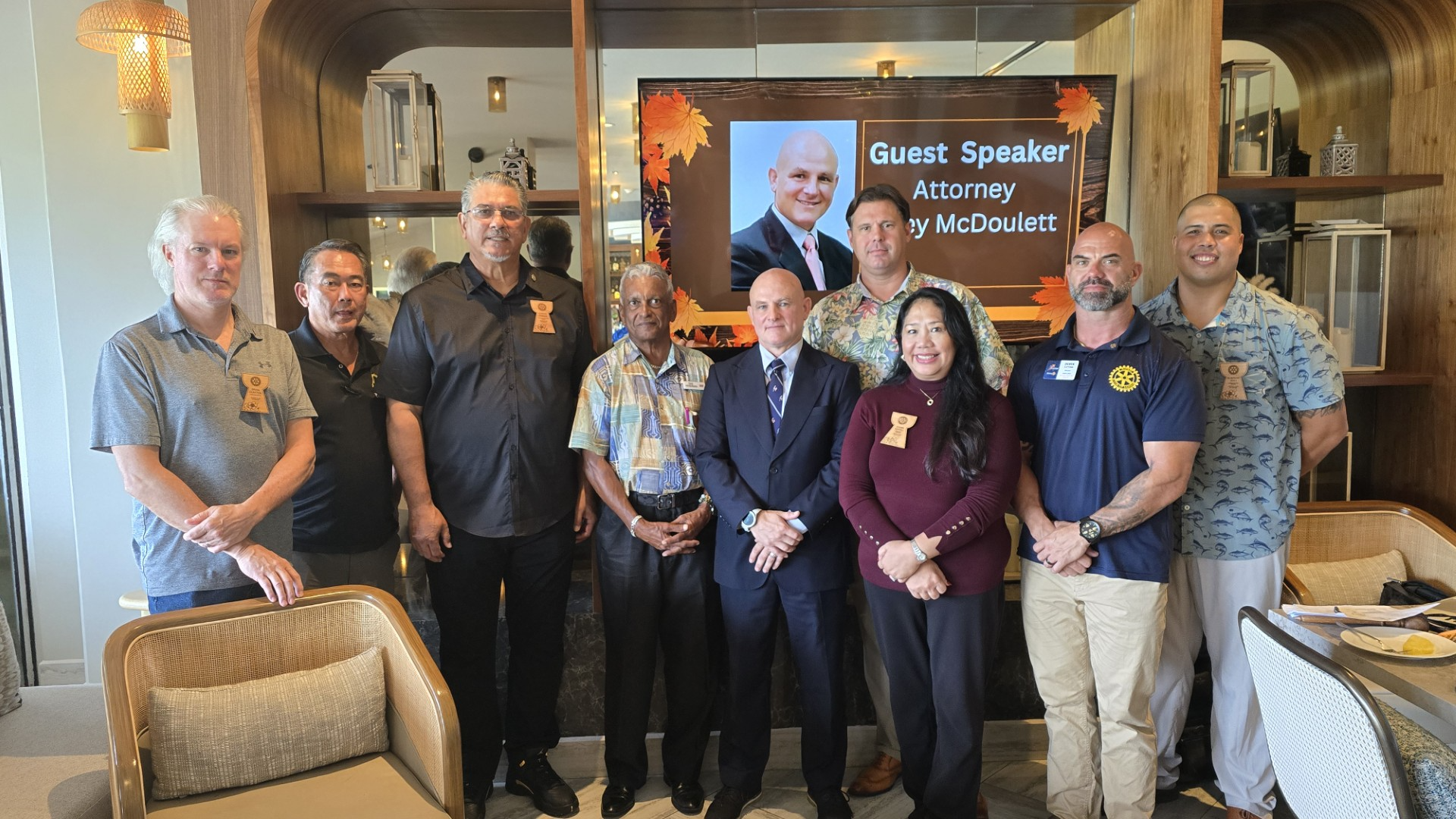
The presentation of Joey McDoulett, fifth from the left, was concluded with a photo with the Rotary Club of Saipan officers last Tuesday afternoon at Mari Bar of Crowne Plaza Resort Saipan.
-RACQUEL FLOYD