Palacios signs budget law, averts partial shutdown
With Lt. Gov. David M. Apatang by his side, Gov. Arnold I. Palacios signed into law on Saturday a budget bill for the government’s operations in fiscal year 2024—but disapproved several parts—averting a government partial shutdown.
Under this budget law, $163.4 million is the total identified budgetary resources for fiscal year 2024. With less debt service, pension obligation, and loan in total amount of $49.1 million, this brings total local revenue and resources available for appropriation to $114.2 million. Including the $4.9 million for the Department of Public Lands, the grand total revenue and resources is $119.1 million.
Unlike his previous signing of a budget law and revised budget, not a single member of the House of Representatives and Senate was present during the signing of this newest legislation, House Bill 23-66, HS1, SS2, CCS1, in the governor’s conference room. The new budget is now Public Law 23-09.
House Speaker Edmund S. Villagomez (Ind-Saipan) said yesterday that he was not aware that they were going to sign the budget bill that time. He was at the Chief Aghurubw Memorial Mass on Managaha Island when he was informed.
Villagomez said he has no comments about the budget law as he has not reviewed it yet.
Senate President Edith E. DeLeon Guerrero (D-Saipan) said yesterday that she was not aware of the press conference and was at a school speaking engagement at the time of signing. She said Palacios called her, however, to let her know he signed the budget but there are concerns that need to be addressed.
She said the governor also apologized for not inviting other lawmakers because they have been up all night reviewing the budget before signing.
Palacios noted that the budget bill, or the Appropriations and Budget Authority Act of 2024, does not meaningfully address the chronic funding shortfall for critical programs and services and, instead, “offers the flawed solution of punting the obligation” to the Executive Branch to use the 100% reprogramming that’s authorized in the legislation.
Before he signed the budget bill, Palacios commended the Legislature for passing a budget bill on time, but noted that every governor would love to have at least two weeks in advance to review it thoroughly.
The House and Senate passed the budget bill last Monday, Sept. 25. Had lawmakers failed to pass a new budget by last Saturday, there would have been a partial government shutdown.
Palacios said the approval of the bill will prevent a government shutdown, allowing continuity of government’s operations and delivery of services to the people.
However, the governor said, there are certain provisions in the legislation that are “very concerning.”
“I’m very concerned that the bill does not sustainably and meaningfully address the chronic funding shortfall for critical programs and services that are mandated,” he said.
Such programs and services, Palacios said, are the Medicaid match, funding for Medical Referral/Health Network Program, Commonwealth Utilities Corp. utilities, Solid Waste Management, Group Health and Life Insurance Program, and the 25% retiree pension payment.
For Medicaid, the Legislature allocated just $6.6 million, which limits the CNMI’s access to only $39 million—not the full $65 million.
The governor said GHLI is practically unfunded and the funding gap basically threatens the continuity of the program, potentially leaving enrollees, both active employees and retirees, without health insurance.
He said the other key points is the reprogramming authority that was given to the Tinian administration by the Legislature.
Palacios said under the skeleton budget appropriation, almost no flexibility is provided him to use the 100% reprogramming authority to move funds within the Executive Branch to cover the already anticipated shortfalls for Medicaid, Medical Referral/Health Network Program, GHLIP, CUC utilities, Solid Waste Management program, and the 25% retiree pension payment.
Palacios said a directive will also have to be issued in the coming days because the budget legislation puts in a 10-hour per pay period austerity—instead of just eight hours—and that’s going to impact government employees.
He said there are issues with payment of utilities in the language for some of the provisions for Tinian and Aguiguan and the other programs.
Palacios also asked the Legislature to fast-track revenue legislations that have already been proposed. “That would generate at least a significant amount of revenue to address some of the shortfalls in government,” he said.
The governor expressed optimism that the CNMI will be moving closer to a path of economic recovery. He said the administration is focusing on fundamental infrastructure projects, diversifying the economy, moving federal dollars to the economy, and strengthening tax collection efforts.
“I look forward to working collaboratively and cooperatively with our Legislature to seriously and honestly look at the challenges ahead and some up with realistic solutions and alternatives to how they [are going] to face these challenges and the problems and really resolve them at least in the short term and then we’ll move on to long-term resolutions,” Palacios said.
Apatang said they have a lot of concerns with the budget bill and the Legislature will hopefully look at it and address their concerns, especially revenue generating bills to support this budget.
“We continue to ask them for cooperation and support so we can get everybody moving forward with the economy,”
Apatang said.
As to why Villagomez and DeLeon Guerrero were not present at the signing, Palacios said it’s Saturday and they wanted to have the staff review the bill again. “It’s okay. It’s Saturday. I didn’t want to bring them in because we weren’t sure what time exactly we were [going to] be signing this,” he said.
Palacios said he visited the Legislature on Friday as he actually wanted to talk to some House members about when the revenue generating legislations would start coming out.
He said he is very concerned with the lack of revenue that the CNMI is facing.
Right now, Palacios said, they are looking at a $30-million Government Health Life Insurance premium pay.
“And we put only about $68,000 into it. So that’s a big concern,” said Palacios, adding that he and Apatang talked briefly with some House members regarding some of their concerns.
In his letter to DeLeon Guerrero and Villagomez on Saturday, Palacios informed them that he has signed the budget bill into law, discussed their concerns, and explained why he disapproved several parts of the budget legislation.
Palacios stated in the letter that the gubernatorial reprogramming authorized in the bill only works if there is sufficient funding available to meet the already anticipated shortfalls. He said such funding has not been appropriated to the Executive Branch in the skeleton budget, with only the estimated sum of $500,000 available for reprogramming.
“Punting obligations downfield or throwing Hail Mary passes hoping for miracles is not the responsible approach to budgeting when lawmakers knowingly approve a spending plan that is not adequately funded,” the governor pointed out.
Palacios noted a disproportionate reduction in funding among the three branches of government, when compared to the fiscal year 2023 amended budget appropriation.
Without question, he said, the Executive Branch has the bulk of the responsibility of providing services and programs for the communities. Under the bill, however, the Executive Branch’s budget allocation for operations (non-personnel) had been decreased by an overall 64%, while the corresponding allocations for Judiciary and Legislature decreased by only 27% and 0.46% respectively, he added.
Additionally, Palacios said, independent programs within the Executive Branch, including the Office of the Attorney General, have also been reduced by approximately 90%.
He said the disproportionate level of funding for the Executive Branch will force a review on whether to reduce, suspend, or close affected programs and government services because of the lack of revenue to support the expenditure plan approved in the budget bill.
Palacios said the Medicaid Program and the GHLIP will see the most drastic drop in service levels, with Medicaid reducing its available federal funds by $26.8 million and GHLIP potentially terminating health insurance coverage.
He said his proposal for the upcoming fiscal year included minimal revenue enhancement to bolster the resources for fiscal year 2024.
The governor said the Legislature has had time to consider his proposal, but has yet to take any action despite promises to pass revenue bills. He said the promises must translate into positive action to approve revenue generating measures in the first quarter of fiscal year 2024 to close the budget gap for these critical programs and services.
“Without the additional revenues, it will be almost impossible to operate the Commonwealth government responsibly on such a [skeleton] budget,” Palacios said.
The governor line-item vetoed several parts of the bill that he has found “unclear, ambiguous, or problematic either in their inconsistency with existing provisions of Commonwealth or federal law, or in their implementation or imposition of additional and unnecessary steps that would hinder efficiency in government operations.”
Under the budget law, $6 million is appropriated to the Judiciary, $6.7 million to the Legislature, and $44.3 million to the Executive Branch.
A total of $7.6 million is appropriated for Rota; $6.3 million for Tinian and Aguiguan; and $1.2 million for Saipan and Northern Islands.
Board and commissions are appropriated a total of $1.6 million; independent programs with $6.7 million; and other programs (transfers to agencies) with $33.4 million.

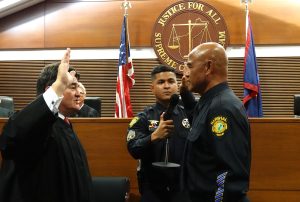
Lt. Gov. David M. Apatang claps after Gov. Arnold I. Palacios signs into Public Law 23-09 the budget bill for the CNMI government’s operations in fiscal year 2023 in the Office of the Governor’s conference room last Saturday.
-FERDIE DE LA TORRE