Proclamation signing turns into a refresher class on NMI history
Yesterday’s proclamation signing for Historic Preservation Week turned into a refresher course on history when Gov. Benigno R. Fitial asked the Historic Preservation Office for more details about the Chamorro and Carolinian history in the CNMI.
Right after signing the proclamation document, Fitial asked HPO historian Genevieve Cabrera if there were records about the time when “Chamorros were forcefully evacuated from Saipan to Guam by the Spaniards,” supporting the contention that there were no Chamorros left on the island when that happened.
Cabrera explained to government leaders that some history books about Saipan were “tainted” to benefit the writers of the book. She added that there were Chamorros who stayed on the island even if majority of them were forced out to Guam.
Lt. Gov. Tim Villagomez quipped in jest, “Well, the Villagomezes stayed.”
The discussion, according to some HPO staff, was very informative as some of the information that were brought up were new to them.
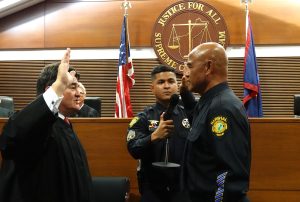
The proclamation, which declared May 21 to 26, was presided by newly appointed HPO director Pedro “Roy” C. Sablan Jr.
Department of Community and Cultural Affairs Secretary Daisy Villagomez-Bier said that “intergenerational sharing” is very important to preserve CNMI history, so working hand-in-hand with the man’amko would be the best way to preserve history.
“I encourage schools, community groups, and families to make time to learn from our living history books, our man’amko,” she said.
Fitial acknowledged government agencies, including the Public School System and the Northern Marianas College, “for also making efforts to preserve our historical knowledge and educate new generations about our culture, traditions, and history.”
The governor said that the CNMI has a very rich and interesting history that includes Spanish colonial occupation, a German administration, and Japanese rule, followed by American liberation at the end of World War II. He said that before the Spanish era, the islands also have the history of the indigenous Chamorros, which is still largely undocumented and are still being explored and investigated.
“I am very proud of our history and development and, as a policymaker, I believe in learning the lessons of history and not repeating the mistakes of the past,” Fitial said.
He stressed that, in order to appreciate where the CNMI is now and where it is heading, it is essential that the local community thoroughly understand their past—where they came from and how they arrived at their current situation.
Cabrera said the HPO would be busy conducting school presentations about the history of the CNMI. There will be open house activities on Rota and Tinian and children will also be invited to join the HPO team on site visits and tours to CNMI shorelines and other historic places in the CNMI where artifacts and evidence of the rich history of the Commonwealth still exist.